I went to the Tokyo Big Sight exhibition centre for the Design Festa at the weekend. Over 2,000 local and international exhibitors took part in this extravaganza of art, fashion and design.
The stands showed the artist's enormous imagination in a wide variety of media from oils and watercolours to wire, glass and plastics. Most of the items were for sale: everything including post cards, T-shirts, shoes, bags, clothes, wigs, hats and general nick knacks.
I recently discovered this quiet oasis while on a bicycle, riding at random around Tokyo. Aoyama Reien is one of the largest cemeteries in Tokyo, just a few minutes from the noise and skyscrapers of Roppongi. And yet, you can hardly hear the traffic, and there are very few people around. Even on a bright Sunday afternoon the place was almost deserted.
What makes this cemetery unusual is not only the size of it, but also the park-like layout. Wide spaces between the graves and trees and bushes make it unlike the majority of Japanese graveyards which are normally small and tightly packed with graves.
First opened in 1872 Aoyama Reien was the first municipal cemetery in Tokyo. Many famous people are buried here include General Nogi Maresuke, a war hero who joined his leader in death by committing suicide when Emperor Meiji died in 1912. Many noted foreigners who came to help modernise Japan in the Meiji era are buried in the small foreign section of the cemetery. A list is maintained at the Foreign Section Trust website, a small group dedicated to preserving the area.
I just missed the Sakura by a week when I was there, you can just see the tail end of the blossoms in some of the photos.
But, if you look closely, this month the native dandelion species Shirobanatanpo are currently in bloom.
Update: 4 days after writing this post, I opened the Japan Times to see an article describing how an interest in history and literature has recently generated a large increase in visitors to Japanese cemeteries. Books featuring tomb tours have also been published, prompting more people to visit cemeteries.
"Sotai Shimashou" ("Let's Clean Moss"), a book published last March by Shueisha Co., features graves of historical figures and Japanese history. According to an editor, the first edition sold 10,000 copies. . So it may not be such a quiet option for much longer.
We stayed at Alishan which is an organic cafe and food shop run by Jack Bayles and his wife Fay. They have an 'Event space' which was our base for the weekend.
Here is Nirmal, demonstrating Yogic Massage on his assistant Naresh.
We also enjoyed Laughing Yoga, which with a small group of Japanese young ladies, was very amusing.
I have recently starting going to the "East West Discussion Group" in Tokyo. I saw an announcement in the Japan Times about one of the discussions which was of interest to my wife. She went the first time and persuaded me to come to subsequent meetings.
It's a small group of mostly elderly but knowlegable and interesting Japanese Ladies and Gentlemen with some Americans. The weekly meetings take the form of a presentation by one the members on a subject of interest, followed by a discussion on the topic.
On my second visit, when the future meetings were being discussed, I was persuaded to do a presentation. I am a bit of a 'railway enthusiast' so I chose to do a talk about 'Trains of the World'. A rather wide subject area I know! I will be showing some photos of trains from around the world and we will be discussing transport related issues.
The talk is on this Thursday 22nd of May, 2008. If anyone in the Tokyo area would like to come along you will be made most welcome . There is no membership requirement or fees, just pay 500 yen on arrival.
The venue is the Hongo Satellite of Tokyo University of Foreign Studies, 7th Floor, 2-14-10 Hongo, Bunkyo Ku, Tokyo. It's less than five minutes walk from exit 1 of Hango Sanchome subway station and looks like this when you get there. The meeting starts at 6:30pm, the presentation usually starts at 6:45 and the meeting finishes at 8:30pm.
This Sunday's day trip took us to Jindai Botanical garden. On the western side of Tokyo, in Chofu-shi , it was established by the Metropolitan Government in 1961. Over 4,500 varieties of plants are artfully planted in the 425,000 square meter gardens.
These fountains with surrounding rose gardens are in front of the large greenhouse. It is the end of the Chrysanthemum season and Jindai, like Shinjuku Gyeon last week, had put on a spectacular display. This is just one plant:
There was also a display of bonsai Chrysanthemums.
This rather large hornet was busy pollinating the camellias.
There are several different routes to the gardens. From Shinjuku we took the Keio Line to Chofu station. We took the number 14 bus from bus stop number 14 at the North exit and got off after 10 minutes at the stop just after the Jindai Temple (one of the oldest in Japan) on the left.
Admission is 500 Yen for adults. Open from 9:30am to 5pm. Closed on Monday, except when it's a holiday when it's closed on the Tuesday.
We discovered the amazing Shinjuku Gyeon this afternoon. This beautifully landscaped park, just a few minutes walk from the hustle and bustle of Shinjuku, is an oasis of calm and greenery.
We were also delighted to find that the annual chrysanthemum display was taking place.
This, believe it or not, is just one plant.
The hundreds of flowers are teased and shaped using a unique technique to produce this remarkable display.
The Ichimonji and Kudmono-giku bed was a spectacular display of these two flower varieties.
The final flower bed on the route through the park is the Ogiku bed. 311 large flowered Chrysanthemums are planted in diagonal stripes. This style named Tazuna-ue is a speciality of the Shinjuku Gyoen.
The display is on until Nov 15. So hurry on down to Shinjuku Gyeon. The entry fee is only 200 Yen and the park is open from 9:00 until 16:30 (Last entry at 16:00). There are three entrance gates the Shinjuku gate is about 10 minutes walk from Shinjuku station.
For those of you unable to get to Tokyo to see it, the New York Botanical garden has a very similar display running until Nov 18th.
If someone had told me last week that there exists a place, only ten minutes drive from Downtown Seoul, that is green and peaceful, with views of undisturbed forest and not a tower block in sight, I would not have believed them.
But, thanks to a Korean friend who took us there, we have discovered such a place. SamcheongGak. This is the view from the terrace looking towards the city fortress walls, beyond the hill is the presidential residence the 'Blue House'
In 1972 the Red Cross built it in the pine forest behind Bukak mountain as a venue to hold a historic meeting between North and South Korea. The buildings were reserved for use by high ranking government officials until 2000 when the Seoul Metropolitan Government bought the site and opened it to the public as a venue for traditional Korean cultural performances in 2001.
This small valley holds a peaceful escape from the hustle and bustle of the city that anyone can visit. There are six traditional buildings, the largest, Ilhwa-dang, contains a restaurant, tea house and the performance hall. This building is used for classes in tradition arts such as the tea ceremony and pottery.
If you'd like to take a trip up to the gate in the fortress walls you'll need to book up at least a week in advance to join one three daily visits to Bukak mountain.
There is no public transport to SamcheongGak, but there is a free shuttle bus service from Gwanghwamun Station (line 5) Exit 3. Buses run daily from 10:00 a.m. to 10:00 p.m. Timetable.
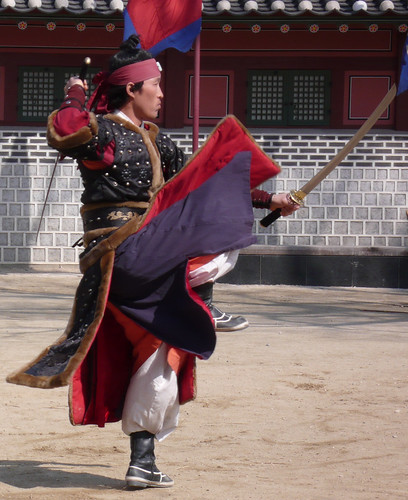
We took a day-trip recently to revisit Suwon. We arrived in front of the palace at 11am just in time to catch a memorable performance of Korean martial arts.
I recorded four of their demonstrations: the Jangchang (long spears), Woldo (moon blade sword with long stick), Kyojeon (swords) and Kwonbeob (unarmed combat). It's a 9min video.
Derek has some very impressive photos from a previous visit.
Walking round the palace there are numerous information posts describing scenes from the well known historical drama series Daejanggeum (Jewel in the Palace) that was filmed here. The show was a big hit in Taiwan as well and draws tourists to visit the sites where their favourite show was recorded. Scenes from The King and The Clown movie were filmed here too. I noticed this phenomenon in YongPyong where there were many signs about movie locations from Winter Sonata.
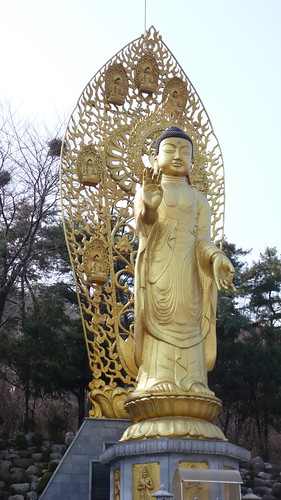
On the hillside above the palace grounds is a temple with an impressive golden Buddha statue.
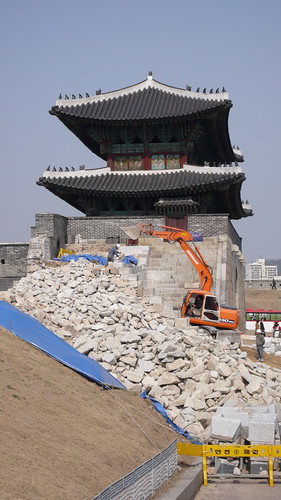
Walking round the Hwaseong Fortress walls we came upon this scene:
No, they are not knocking it down, but rebuilding it, having rerouted traffic around the other side of the gate.
This is Buksumun, the nothern gate, built over the Suwoncheon (river) that runs through the middle of the fortress. It was completed on Jan 13th 1795 having been constructed in less than a year.
The fortress walls have been completely rebuilt and total over 5.7km. It was the most up to date fortress possible at the time it was built between 1794 and 1796. The king sent the designers all over the world to gather the best ideas for it's construction. It is now a UNESCO world heritage site.
To get there from Seoul, take subway line number 1 to Suwon station. It takes about an hour from downtown. Pick up a map at the tourist information office just outside the station and take a city bus number 11,13,36 or 39 into the centre of the town to Paldalmun, the South Gate. If you have a U-Pass card it works on the local buses, if you have a T-money card you'll have to pay cash.